Buying Land in the Adirondacks? Read This Before You Make an Offer
Buying Land in the Adirondacks? Read This Before You Make an Offer
What do you need to know before buying land in the Adirondacks? Before you make an offer on Adirondack land, confirm the parcel's Adirondack Park Agency land-use classification, verify legal road access, and check whether the lot can support a well and septic system. Those three factors decide whether "buildable" is real or wishful.
Why Adirondack Land Isn't Like Buying a Lot Anywhere Else
You found the acreage. There's a view, maybe a creek, and a price that feels like a steal compared to the coast or the suburbs. Before you get attached, understand that the Adirondack Park is unlike almost any other place you'll buy land in the United States.
The Park covers roughly six million acres of public and private land woven together—a patchwork where a working farm can sit next to protected forest preserve. That mix is exactly what makes the region beautiful and what makes buying here more complicated than clicking "make offer." A parcel that looks identical to the one next door can carry very different rights depending on how it's classified and where the buildable ground actually sits.
None of this should scare you off. Owning land across communities like Lake Placid, Saranac Lake, Keene Valley, Wilmington, Jay, and Tupper Lake remains one of the more grounded long-term plays in the region. But smart home buying tips start with knowing what questions to ask—so let's walk through them before you sign anything.
Start With the Adirondack Park Agency Classification
The single most important thing to check on any Adirondack parcel is its land-use classification under the Adirondack Park Agency (APA). The APA regulates development on private land inside the Park, and your parcel's classification largely determines what—and how much—you can build.
Private land generally falls into categories ranging from Hamlet (the most development-friendly, usually near town centers) to Rural Use and Resource Management (the most restrictive, with large minimum lot sizes and low building density). The classification affects:
- The minimum lot size required to build
- How many principal buildings the land can support
- Whether you'll need APA review or a permit before construction
Two sellers can both call their listing "buildable." Only one may be telling the whole story. Ask for the classification in writing, and if a build is central to your plans, confirm with the APA directly before you commit.
Confirm Legal Access—Not Just a Trail to the Property
A parcel is only as useful as your right to reach it. In the backcountry, plenty of beautiful lots are effectively landlocked or reachable only by a seasonal road the town doesn't plow or maintain.
Before you make an offer, verify:
- Deeded, legal road access to a maintained public road, or a recorded right-of-way across a neighbor's land
- Year-round access if you plan to live there or build—seasonal access changes construction timelines and insurance
- Utility reach, meaning how far the nearest power line runs and what a hookup would cost
Ask the seller and your attorney to show you the access in the deed, not just on a map. "You can drive right up to it in July" is not the same as a legal, recorded right to use that road in February.
The Off-Grid Reality: Wells, Septic, and Perc Tests
Most rural Adirondack land has no municipal water or sewer. That means a private well and an on-site septic system—and not every lot can support one.
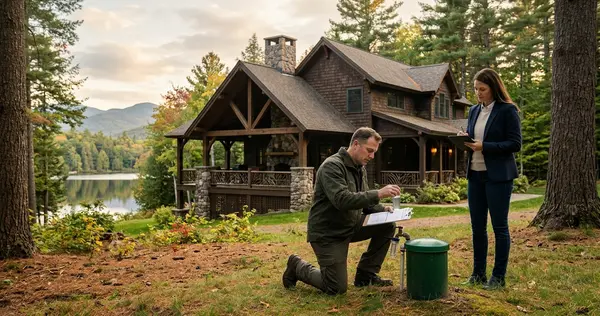
Whether a parcel can handle a conventional septic system depends on soil type, depth to bedrock, and the water table. The standard way to find out is a percolation ("perc") test and a soil evaluation. Rocky ground, high groundwater, or thin soil over ledge can require an engineered system that costs far more than a standard one—or can rule out a build entirely. Penn State Extension offers a clear primer on how septic systems and soil suitability work if you want to understand the mechanics before you talk to a local engineer.
The practical home buying tip here: whenever possible, make your offer contingent on a satisfactory perc test and soil evaluation. Paying for that testing up front is far cheaper than discovering after closing that your dream cabin site can't legally handle a septic system.
Wetlands, Shorelines, and Steep Slopes
The features that make Adirondack land gorgeous are often the same ones that restrict building on it.
- Freshwater wetlands fall under APA jurisdiction, and building near or within them is limited.
- Shoreline lots carry setback requirements and restrictions on cutting vegetation near the water—rules designed to protect water quality that also shape where and how you can build.
- Steep slopes raise engineering, driveway, and septic costs and can limit the usable footprint.
If waterfront is on your wish list, understand that a shoreline premium comes attached to a rulebook. The New York State Department of Environmental Conservation is a useful reference for understanding how state lands, easements, and water protections interact with private parcels across the Park.
Understanding Adirondack Land Market Trends
Adirondack land doesn't move like a subdivision lot in a metro market. Inventory is limited, demand for private acreage and waterfront has stayed strong, and comparable sales can be thin—two "similar" 10-acre parcels may price very differently based on access, buildability, and water frontage.
Because pricing here is so parcel-specific, national headlines only tell you so much. It's worth tracking broad market trends through resources like the National Association of Realtors research center and Realtor.com's market research for context, then leaning on local expertise for what a specific Adirondack parcel is actually worth. A regional overview from Adirondack.net can also help you get oriented to the different communities before you narrow your search.
Investment Advice for Adirondack Land Buyers
If you're buying with an eye toward returns rather than an immediate build, a few pieces of practical investment advice apply.
Think in terms of what actually drives value here: legal access, buildability, water frontage, and proximity to hamlets and recreation. A remote, landlocked, non-buildable parcel is cheap for a reason. A well-positioned lot with year-round access and a viable build site is where long-term value tends to concentrate.
If short-term rental income is part of your thesis, know that rules vary by municipality and can change. Some Adirondack communities regulate short-term rentals closely—Saranac Lake, for example, requires local ownership and a permit to operate a short-term rental within village limits (see the Saranac Lake short-term rental law). Always confirm the current local rules before you build an investment plan around rental income, and treat tax and legal questions as matters for your accountant and attorney rather than assumptions.
A Simple Pre-Offer Checklist
Before you make an offer on any Adirondack parcel, run through this:
- APA classification — confirmed in writing, verified with the Agency if you plan to build
- Legal access — deeded access or recorded right-of-way, year-round if needed
- Perc test and soil eval — ideally as an offer contingency
- Wetlands, shoreline, and slope — understand what's restricted
- Survey and boundaries — a current survey beats an old map
- Title and easements — check for conservation easements, timber or mineral reservations, and liens
- Taxes and financing — land loans differ from home loans; confirm terms early
Frequently Asked Questions
Do you need a permit to build on land in the Adirondacks? Often, yes. Depending on the parcel's Adirondack Park Agency classification and features like wetlands or shorelines, you may need APA review or a permit in addition to local building permits. Always confirm before you buy if building is your goal.
Can you get a mortgage for vacant land in the Adirondacks? Vacant land is typically financed with a land loan rather than a standard mortgage, and these usually require larger down payments and carry different terms. Talk to a lender early so you know your real budget before you make an offer.
What makes Adirondack land buildable? A buildable Adirondack parcel generally needs a favorable APA classification, legal year-round access, and soil that can support a well and septic system. Missing any one of those can turn an attractive price into an unusable lot.
Ready to Find the Right Adirondack Parcel?
Buying land in the Adirondacks rewards buyers who do their homework—and it's a lot easier with local guidance that knows the difference between a great lot and a great-looking one. Explore current listings and land opportunities across the Adirondack Park at tinaleonardrealestate.com, subscribe to our newsletter for market trends and new parcels as they come available, or reach out for personalized advice tailored to your goals.
For a conversation about buying land or a home anywhere in the Adirondack Park region, contact Tina Leonard Real Estate, LLC, at 518-524-3273.
Categories
Recent Posts




OUR MISSION
We're proud to be part of the following global networks of distinguished brokerage companies: