
AI Is Changing Home Buying, Here's What Adirondack Buyers Need to Know
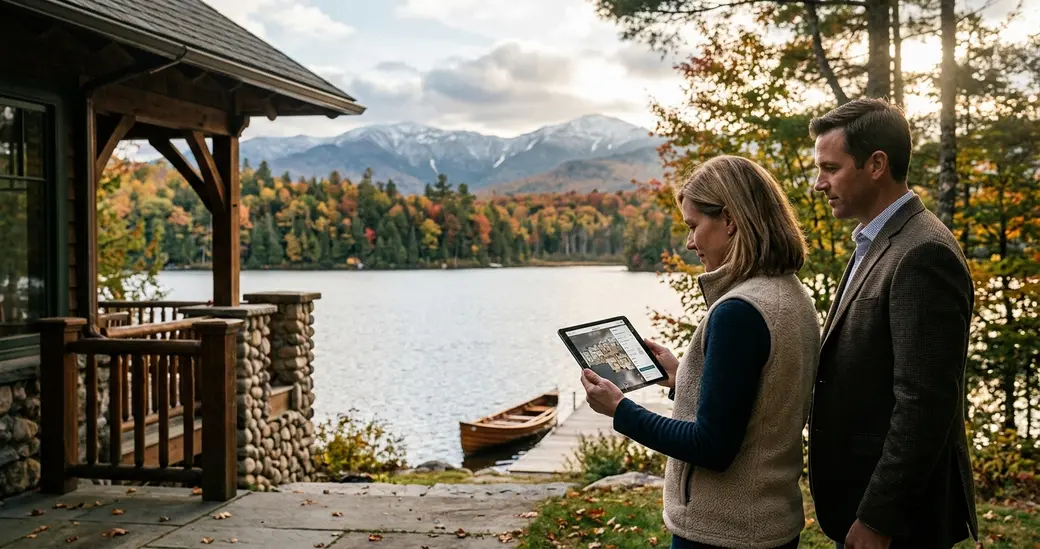
AI Is Changing Home Buying, Here's What Adirondack Buyers Need to Know
How is AI changing home buying in the Adirondacks? Artificial intelligence now powers the search tools, price estimates, listing photos, and lender chatbots most buyers use, but AI struggles with the Adirondacks' rural comps, seasonal demand, and Adirondack Park rules, so local expertise still decides the deal.
Five years ago, house hunting in the Adirondack–Champlain Valley meant a spreadsheet, a stack of printouts, and a lot of Saturday drives. Today, an algorithm greets you the moment you open a listing app. AI ranks the homes you see, estimates what they're worth, writes the descriptions, sometimes enhances the photos, and may even answer your first questions about financing. That's a genuinely useful shift, if you know where the technology shines and where it quietly falls apart.
And in a market like ours, it falls apart in specific, predictable places. The Adirondack Park is unlike almost any residential market in the country: thin sales data, one-of-a-kind camps, waterfront and off-grid properties, seasonal roads, and land-use rules that a national model has never heard of. Below are the practical home buying tips that help you use AI as a tool without letting it make decisions it isn't equipped to make.
AI Home Value Estimates Are a Starting Point, Not a Price
The most visible way AI touches home buying is the automated valuation model, or AVM, the "estimate" you see on nearly every listing. Tools like the Redfin Estimate and similar features on Realtor.com and Zillow use machine learning to guess a home's value from recent comparable sales.
These models work reasonably well in dense suburbs where hundreds of near-identical homes trade every year. They work poorly here. An AVM needs comps, recent sales of similar nearby properties, and much of Essex, Clinton, and Franklin County simply doesn't generate enough of them. A lakefront cottage in Wilmington, a converted great camp near Lake Placid, and a raw-land parcel in Franklin County have almost nothing statistically in common, so the algorithm fills the gaps with assumptions.
A few home buying tips for using AVMs the smart way:
- Treat the estimate as a rough range, not a number. On unique or rural Adirondack properties, an AVM can miss by 20% or more in either direction.
- Ask what the model can't see. Frontage quality, water depth, a new septic system, a failing roof, seasonal-only road access, none of it reliably shows up in an automated estimate.
- Get a comparative market analysis from someone who knows the Tri-Lakes. A local review that weights the right recent sales will always beat a national model on a property like yours.
AI-Generated Listing Content: Verify Before You Fall in Love
A growing share of what you read and see online is now machine-assisted. AI writes listing descriptions, "virtually stages" empty rooms, and enhances photos to look brighter and more spacious. Used honestly, these tools help sellers present a home well. Used carelessly, they set up a disappointing showing.
Protect yourself with a simple habit: separate what's real from what's rendered.
- Look for "virtually staged" labels on furnished-looking photos of otherwise empty rooms, and ask for the unedited originals.
- Read the description for specifics, not adjectives. AI is very good at "charming" and "must-see" and much worse at square footage, heating source, and year the well was drilled. Chase the facts.
- Always confirm in person. No enhanced photo tells you how the driveway handles in March or whether the "lake views" survive once the leaves come in.
Using AI for Research, Without Getting Burned
ChatGPT, Google's AI Overviews, and similar tools are genuinely handy for learning the basics: what a septic inspection covers, how a well is tested, what closing costs run in New York. Where they get people in trouble is local specifics, because AI confidently states things that are outdated or simply wrong.
Three Adirondack facts AI routinely botches:
- Adirondack Park Agency (APA) rules. Most of the Park is subject to APA land-use classifications that affect what and where you can build. A national chatbot has almost no reliable grasp of this. Start with an authoritative local resource like Adirondack.net and verify anything land-related with the APA or your agent.
- Short-term rental regulations. If you're eyeing a property as an income opportunity, rules vary sharply by town and change often. Saranac Lake, for example, regulates short-term rentals under a specific local law; buyers should review the Village of Saranac Lake short-term rental law directly rather than trusting an AI summary. (This is general information, not a rental-service offering.)
- Insurance and access. Wildfire, flood zones, and seasonal road maintenance all affect insurability and lending, and AI tends to answer as if every property sits on a plowed year-round road. Many here don't.
The rule of thumb: use AI to form good questions, then get the answers verified by someone accountable for being right.
AI in Mortgages and Lending: Know Your Footing
AI has moved into financing, too. Many lenders now use chatbots for first-contact questions and algorithmic models to help evaluate applications. That can speed things up, but it also means an automated system may be shaping your early experience.
A couple of guardrails. First, a chatbot's answer about your rate or approval odds is not a commitment, get anything that matters in writing from a human. The Consumer Financial Protection Bureau maintains plain-language mortgage tools and guidance worth reading before you talk to any lender. Second, you always have the right to clear, human answers about the terms of your loan. (Tina Leonard Real Estate does not recommend specific lenders, choosing a mortgage provider is your decision.)
Market Trends: What's Real and What's Hype
Zoom out and the honest picture is this: AI has changed how people shop far more than it has changed what Adirondack homes are worth. The fundamentals still drive our market trends, limited inventory, strong second-home and relocation demand, and the enduring pull of Lake Placid, Saranac Lake, and the surrounding Champlain Valley. For the national backdrop on rates and housing conditions, Freddie Mac's research is a solid, non-hype source, and the National Association of Realtors tracks how technology is actually being adopted across the industry.
The practical takeaway for buyers and investors: AI is excellent at surfacing options and terrible at judgment calls. It can show you thirty properties in Keene Valley in ten seconds. It cannot tell you which one will hold value when the seasonal-rental math, the APA classification, and the well test all come into focus. That's where sound investment advice, rooted in local sales data and boots-on-the-ground knowledge, still earns its keep.
Actionable Checklist for the AI-Era Adirondack Buyer
- Use AVMs as a range, then get a local CMA before you offer.
- Request original, unedited photos and confirm every home in person.
- Ask AI for questions to research, not final answers on local rules.
- Verify APA, short-term rental, and insurance details with accountable local sources.
- Keep a human in the loop on anything involving money or contracts.
Frequently Asked Questions
Are online home value estimates accurate in the Adirondacks? Often not. Automated valuation models rely on recent comparable sales, and rural areas like Essex, Clinton, and Franklin County frequently lack enough comparable properties. Treat any online estimate as a wide range and get a local comparative market analysis before making an offer.
Can I trust AI tools like ChatGPT for Adirondack real estate advice? Use them for general education, not local specifics. AI regularly gets Adirondack Park Agency rules, short-term rental laws, and property-access issues wrong. Confirm anything local with an authoritative source or a licensed agent who works the market daily.
Does AI make it easier to invest in Adirondack property? It makes research faster, but it doesn't replace judgment. AI can screen listings and pull rough numbers, yet sound investment advice here depends on local factors, seasonal demand, regulation, insurability, that national models consistently miss.
Ready to Buy Smart in the Adirondacks?
AI can hand you more information than ever, but the right home, and the right price, still comes down to local knowledge. Tina Leonard Real Estate helps buyers across Lake Placid, Saranac Lake, the Tri-Lakes, and the greater Champlain Valley cut through the noise and make confident, well-informed decisions.
Explore current listings, subscribe for local market updates, or reach out for personalized guidance tailored to your goals. To get started, contact Tina Leonard Real Estate at 518-524-3273 or visit tinaleonardrealestate.com.
Categories
Recent Posts








"My job is to find and attract mastery-based agents to the office, protect the culture, and make sure everyone is happy! "